The personal AI OS race is really a memory and permissions race
CORE’s architecture points to the operational issues every proactive assistant will face.
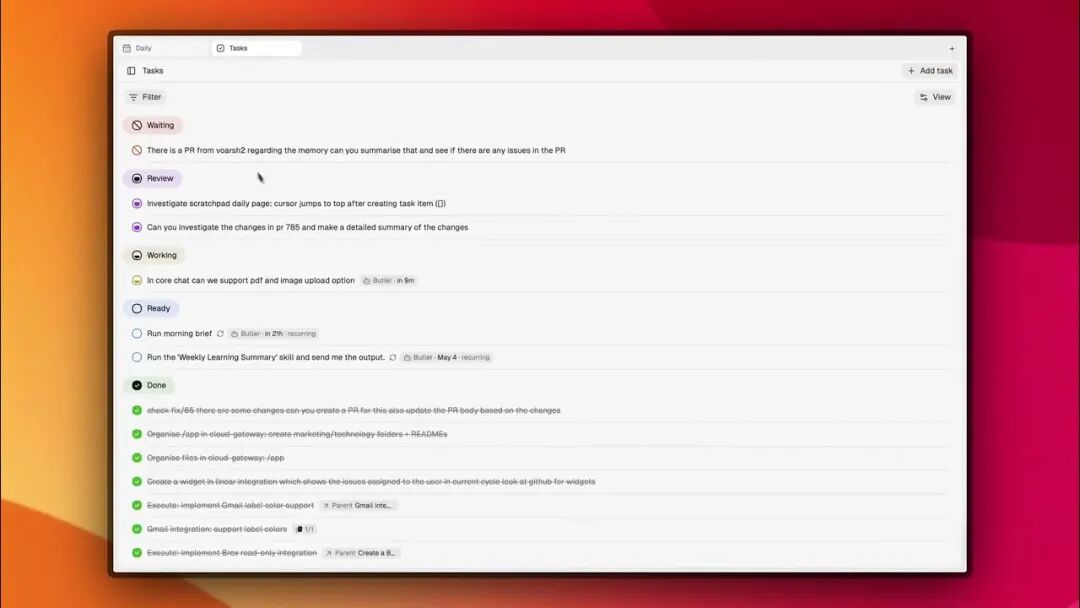
The phrase “personal AI OS” can sound like marketing until you look at the operational requirements. An assistant that is always watching and ready to act needs more than a chat interface. It needs memory, event intake, task state, tool permissions, execution environments, and audit trails. CORE is interesting because it puts these pieces in one self-hostable system.
The product category is forming
The first wave of AI products was conversational. The next wave is operational. Users do not only want a model to respond; they want it to notice a Sentry alert, check the relevant repository, summarize the likely cause, draft a fix plan, and ask for approval before opening a pull request. That requires a different product architecture from a chatbot.
CORE’s four-part structure—memory, tasks, connectors, and gateway—maps directly to that shift. Memory preserves context. Tasks provide continuity and ownership. Connectors bring in events from real tools. The gateway gives the assistant hands. Remove any one of those layers and the product becomes either a note-taking system, a dashboard, or a one-off agent runner.
Trust is the bottleneck
The hard part is not adding more integrations. It is defining when the system may act. A proactive assistant can save time, but it can also create silent damage if it acts on stale memory, sends an email too early, edits the wrong repository, or treats a preference as a permanent rule. This means the permission model is a core product feature, not an enterprise checkbox.
- Human approval should be configurable by tool, action, and context.
- High-risk tools need narrow scopes and visible logs.
- Memory needs user-facing inspection, correction, and deletion.
- Autonomy should increase after repeated successful low-risk runs, not by default.
Self-hosting is a wedge, not a complete answer
Self-hosting helps with control, but it does not automatically solve governance. A local gateway still needs secret handling, sandboxing, path restrictions, rate limits, and observability. For many technical users, self-hosting is attractive because they can inspect and shape the system. For mainstream users, the same setup burden may be too high until the product becomes more managed.
Bottom line
CORE points to a real category: personal or team-level AI infrastructure that sits across apps and execution environments. The winners will not be the systems with the loudest “AI OS” branding. They will be the ones that make memory trustworthy, permissions understandable, and actions reversible.