Free model quotas are a go-to-market lever, not an infrastructure plan
Gemini’s free tier shows how model providers buy developer attention, and why builders still need exit paths.
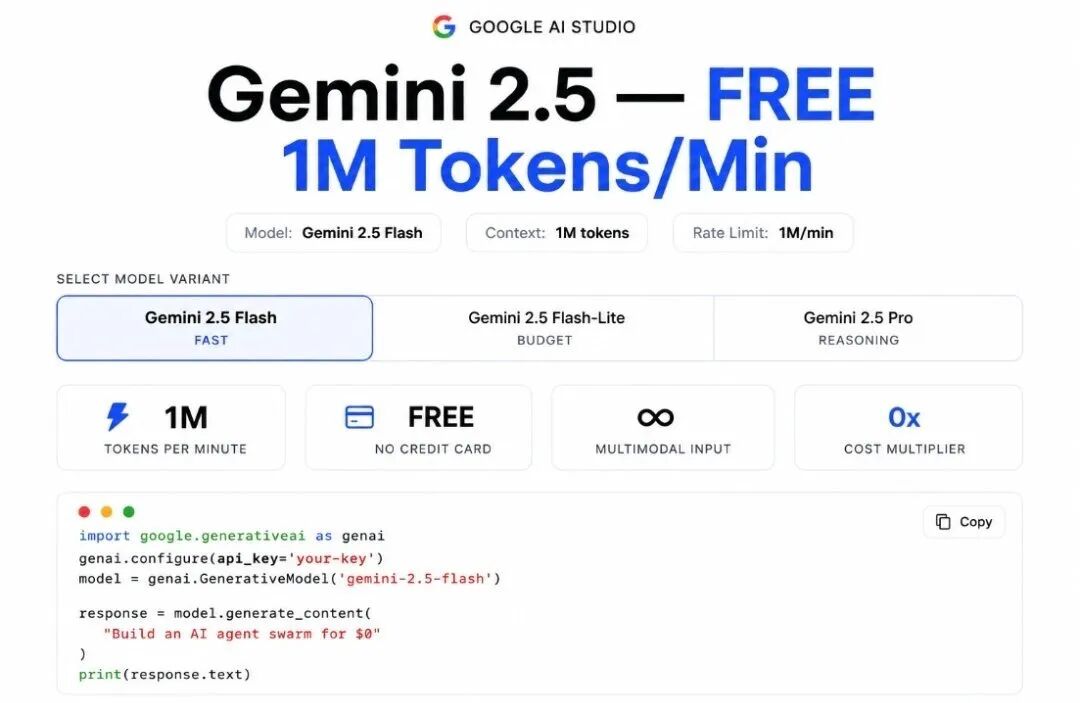
A large free Gemini API quota is not just a developer perk. It is a distribution strategy. Model providers want builders to start projects on their stack, write tutorials around their endpoints, and normalize their SDKs inside new products. The free tier buys attention at the exact moment when product architecture is still fluid.
The economic signal is obvious
For an independent developer, the immediate benefit is real: more prototypes become cheap enough to attempt. For Google, the benefit is also real: every successful prototype increases the chance that a future production workload lands on its paid tier. The tension is not cynical; it is how cloud platforms have always worked. Credits, free databases, free compute hours, and now free tokens all serve the same purpose.
The mistake is to confuse acquisition pricing with long-term unit economics. If a product only works while inference is free, it is not yet a business. The correct question is not “Can I run this today?” but “What happens when usage is 10x higher, the free tier shrinks, or the data policy requires paid usage?”
Design the exit before the lock-in forms
- Keep prompts and response schemas provider-neutral where possible.
- Avoid provider-specific features in the first version unless they are the core product value.
- Record token cost per user action, not only total monthly spend.
- Build a fallback model path before the first public launch.
- Treat free-tier demos as demos, not as proof of sustainable margin.
The strongest use case is market discovery
Free model access is best used to answer product questions: Will users upload this type of document? Is the extraction reliable enough? Do people pay for automation or only praise the demo? Which step actually needs a frontier model? These questions are more important than maximizing token consumption. A disciplined team will use the free window to identify the expensive calls, remove unnecessary context, and replace model work with deterministic code where possible.
That discovery work makes the product more robust even if the provider changes. Once the team knows which calls create value and which calls are waste, pricing changes become manageable rather than existential.
Bottom line
The free Gemini tier is worth using, especially for experiments and low-risk automation. But the strategic lesson is broader: model providers are competing for default position inside developer workflows. Builders should accept the subsidy, learn quickly, and keep enough abstraction to leave when the economics, policy, or performance stops fitting.