The bottleneck in AI side income is problem selection
A pragmatic view: tools matter only after a person has a real problem, audience, and repeatable delivery path.

The business question behind AI side income is not “Which tool should I learn next?” It is “Which repeatable problem can I operate better than the people currently living with it?” From a product and operations perspective, AI matters only after a person has chosen an audience, a pain point, a delivery promise, and a feedback loop.
Think in systems, not in tools
People often evaluate AI by feature lists: better coding, better writing, better agents, better automation. Those capabilities are real, but revenue usually comes from a system that converts an observed problem into a repeatable offer. The system includes discovery, packaging, delivery, support, improvement, and distribution. A tool can help at each step, but it cannot decide the operating model for you.
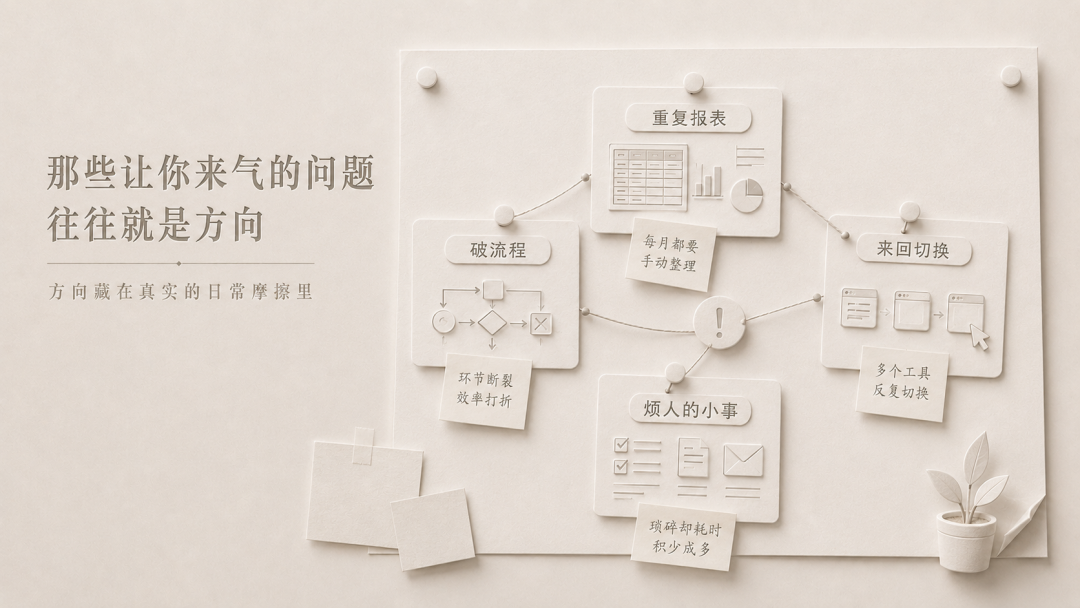
The strongest directions tend to come from places where you already see messy details. Internal reporting, onboarding documents, compliance checks, sales research, QA summaries, content repurposing, and customer-success handoffs are not glamorous, but they have measurable before-and-after states. If you can make one of those workflows faster, clearer, or cheaper, you can build a productized service or a small software layer around it.

The product angle: package the outcome
A solo AI business becomes durable when the customer understands the outcome without understanding the machinery. “I use several agents and prompts” is not an offer. “I turn your weekly support tickets into a prioritized product report every Friday” is an offer. “I build a searchable knowledge base from your messy internal docs” is an offer. The customer buys the reduction of uncertainty, not the novelty of the toolchain.
- Start with a narrow user group whose workflow you can observe directly.
- Describe the painful moment in operational language: delay, rework, missed context, manual copying, or unclear ownership.
- Package the result as a recurring deliverable, not a one-off experiment.
- Use AI to standardize the invisible work: extraction, drafting, formatting, checking, routing, and reporting.
- Keep human review where mistakes would damage trust, ownership, or money.

Evaluation checklist for a real opportunity
Before committing to another tool subscription, evaluate whether the direction has operational gravity. A good opportunity should be easy to describe, painful when ignored, and capable of becoming more efficient every time you deliver it.
- Who owns the pain today, and what happens if they do nothing?
- How often does the workflow repeat: daily, weekly, monthly, or only once?
- What artifacts prove the problem exists: tickets, spreadsheets, chats, screenshots, logs, emails, or meeting notes?
- Can AI reduce labor while preserving review, accountability, and data security?
- Can the workflow become a template, dashboard, managed service, micro-SaaS, or internal tool?
Adoption path
The safer route is to run a small operational pilot. Choose one workflow, define the input and output, deliver it manually with AI assistance, then automate only the parts that repeatedly prove stable. This prevents the classic trap of building a clever tool before confirming that anyone wants the outcome.
- Interview three to five people who already perform the workflow.
- Produce one paid or permission-based pilot deliverable.
- Document each step, including the judgment calls that AI cannot safely make alone.
- Turn stable steps into prompts, scripts, templates, or integrations.
- Use the pilot results to refine pricing, positioning, and scope.
Conclusion
AI side income becomes realistic when it is treated as an operating model rather than a tool hobby. Pick a repeatable problem, package the outcome, build a feedback loop, and let AI reduce the cost of delivery. Direction is the product decision that makes every tool choice easier.
